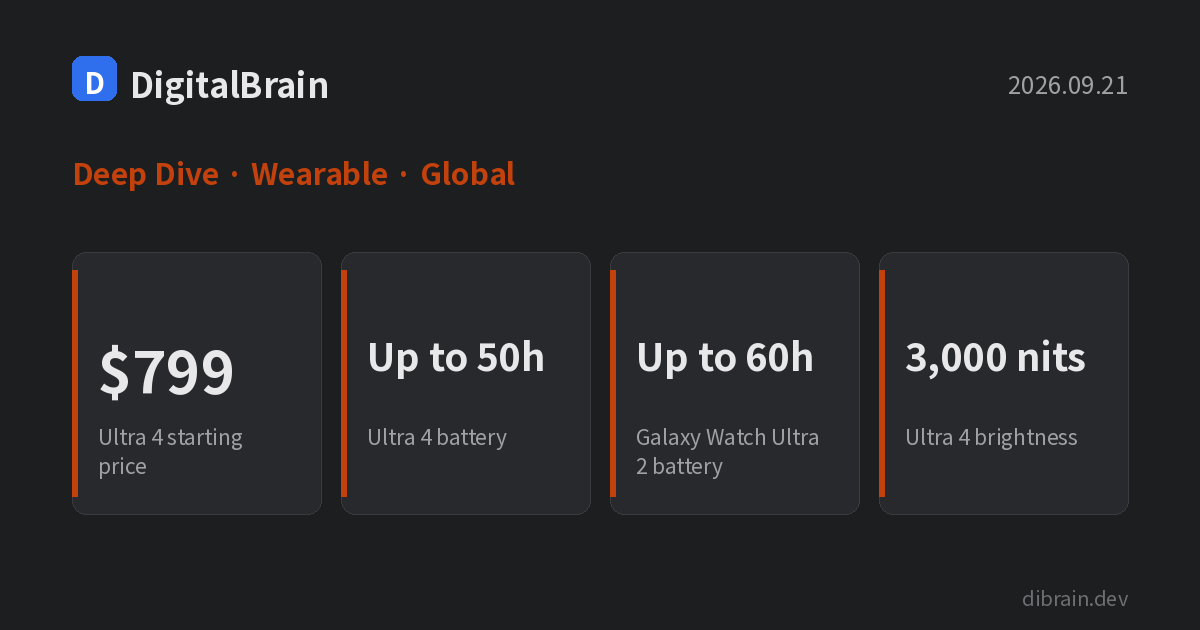
Apple unveiled the Watch Series 12 and Ultra 4 on September 9, and both went on sale on September 18 — Korea included in the first wave, alongside a new AirPods 5 we’re not covering here. Neither watch got a redesign; the changes are concentrated in the heart-rate sensor and battery management. Since Samsung’s Galaxy Watch Ultra 2 already occupies the same “Ultra” tier, we put the numbers side by side.
Ultra 4 / Series 12
| Spec | Ultra 4 | Series 12 |
|---|---|---|
| Chip | S11 | S11 |
| Battery (typical use) | Up to 50 hours | TBC |
| Battery (Low Power Mode) | Up to 84 hours | - |
| Battery (Extended Workout, continuous GPS + heart rate) | 25 hours | - |
| Heart-rate sampling | TBC | Every 5 seconds (60x more often) |
| Display brightness | 3,000 nits | TBC |
| Size | 49×44×12mm | TBC |
| Weight | 63-63.1g | TBC |
| Material | Titanium | Aluminum / Titanium |
| Satellite | Emergency SOS | None |
| Price (US) | From $799 | From $399 |
| Price (Korea) | From ₩1,249,000 | From ₩599,000 |
Ultra 4 keeps the same shell as its predecessor and puts its changes into an entirely new health-sensing system and battery management. Its price hasn’t moved either: Ultra 4 starts at $799, the same as Ultra 3, even with the overhauled sensors. The 25-hour Extended Workout figure covers continuous GPS tracking with heart-rate monitoring running the whole time — the scenario that drains a watch fastest — while the 50-hour number describes more typical mixed use, and 84 hours applies only with Low Power Mode switched on, which turns off several always-on features. Series 12’s aluminum-model front glass is 60% tougher than before, and its new heart-rate sensor samples every 5 seconds — 60 times more often than the previous generation. Both models also gain a new “readiness” score that combines activity, vital signs, and sleep data to flag whether you’re primed for a hard workout or need to recover.
Against the Galaxy Watch Ultra 2
| Spec | Apple Watch Ultra 4 | Galaxy Watch Ultra 2 |
|---|---|---|
| Battery (typical use) | Up to 50 hours | Up to 60 hours |
| Display brightness | 3,000 nits | 5,000 nits |
| Processor | S11 | Snapdragon Wear Elite |
| OS | watchOS, iOS-only | Wear OS, Android-only |
| Size | 49×44×12mm | 47.4×47.1×10.7mm |
| Weight | 63-63.1g | 61.5g |
| Material | Titanium | Titanium |
| Price (US) | $799 | $649-699 |
| Price (Korea) | ₩1,249,000 | ~₩969,100 |
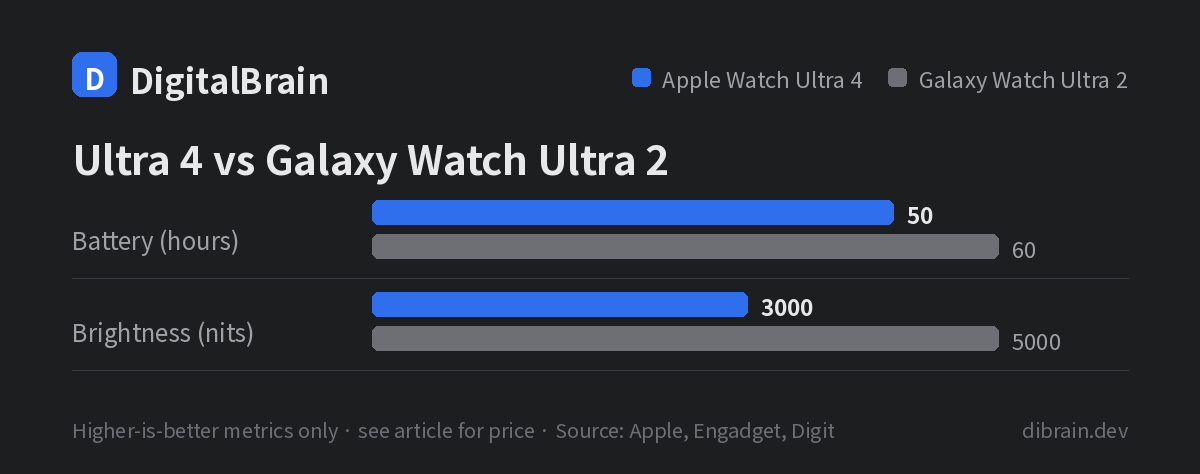
Galaxy Watch Ultra 2 beats Ultra 4 by 10 hours of battery and 2,000 nits of brightness, and it costs roughly $130-150 less in the US, about ₩280,000 less in Korea. The battery figures Apple is promoting — 50 hours, or 84 in Low Power Mode — still fall short of the competitor’s baseline number, and that’s before accounting for the fact that Apple’s 50-hour figure is itself a best-case claim for typical use rather than a guaranteed minimum.
Trade-offs and who each watch fits
Ultra 4’s case rests on satellite Emergency SOS, Apple Intelligence, and iOS integration. If you’re on an iPhone and need satellite SOS for hiking or diving where signal drops out, Ultra 4 is the pick. If battery life, outdoor visibility, and price matter more, Galaxy Watch Ultra 2 wins on all three — though it’s Android-only, so iPhone owners aren’t choosing between the two anyway. For an Android user weighing both platforms, the math is more one-sided: a longer-lasting, brighter, cheaper watch, with the only real trade-off being the loss of satellite SOS and Apple’s software ecosystem.
Series 12 drops the satellite feature and targets everyday wear; the 5-second heart-rate sampling is this generation’s headline change. For a daily health watch rather than an outdoor-adventure one, Series 12 makes more sense than Ultra 4. The price gap between the two Apple watches is substantial too — Ultra 4 costs $400 more than Series 12 in the US, a difference that buys the titanium case, satellite SOS, and the extended battery modes.
Availability in Korea
Both models are already on sale in Korea as of September 18, the same day as the US launch. Pre-orders opened on September 9, right after the announcement, and Korea was included in that first wave rather than a later rollout — a pattern Apple has kept consistently for its wearables in recent years. Series 12 starts at ₩599,000, Ultra 4 at ₩1,249,000.
Verdict
This generation of Apple Watch is a health-sensor and battery-management update rather than a redesign. But the battery numbers Ultra 4 leads with don’t even match the Galaxy Watch Ultra 2’s baseline specs, and it costs more on top of that. Its 3,000-nit display also trails the competitor’s 5,000 nits, which matters most exactly when you’re outdoors checking a watch face in direct sun. Unless you need iOS lock-in or satellite SOS, this upgrade gives more reasons to stay put than to switch. And for anyone already on iPhone, the comparison is academic anyway — Galaxy Watch Ultra 2 doesn’t pair with iOS at all, so the two were never really competing for the same buyer.