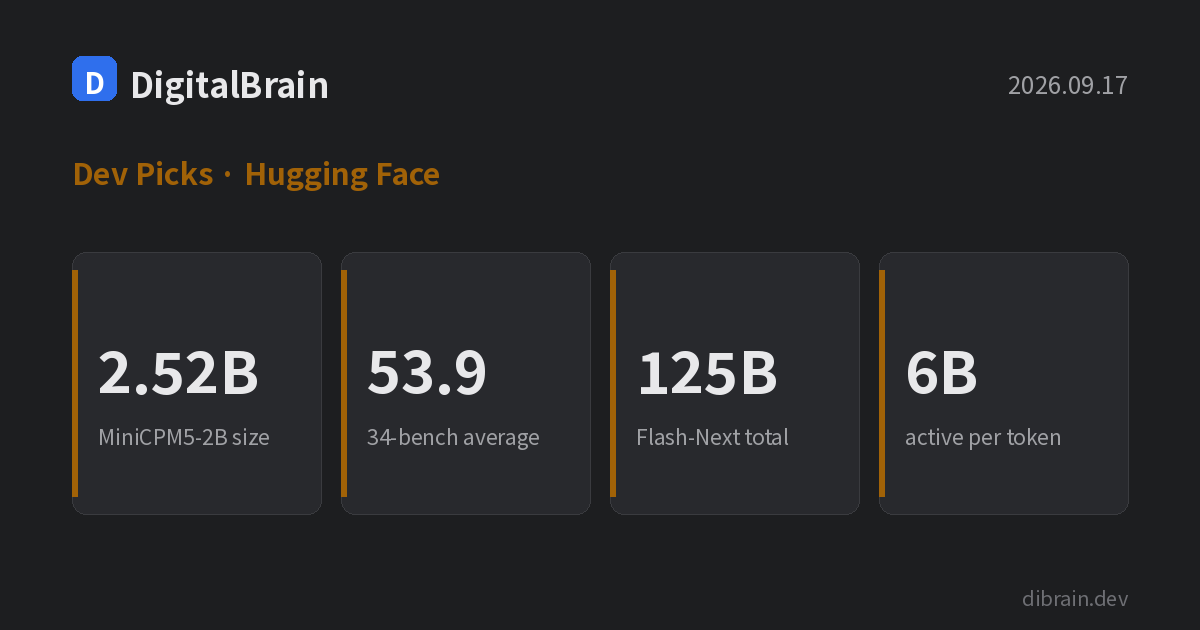
Two picks from this week’s Hugging Face trending list take opposite routes to the same goal. One shrinks the whole model to win. The other keeps the total size but only wakes up a fraction of it per token. Both target the same practical problem — running a capable model without sending every request to someone else’s cloud — but they solve it at completely different scales. If you want something to run on your own hardware, both are worth a look.
MiniCPM5-2B
- Model card: openbmb/MiniCPM5-2B
- Source: GitHub - OpenBMB/MiniCPM
- Publisher: OpenBMB
- License: Apache-2.0
- Parameters: 2.52B dense, 42 layers, GQA (16 query heads / 2 KV heads)
- Context: 131,072 tokens
- Released: 2026-09-07
The second checkpoint in the MiniCPM5 line, built for local and on-device use rather than cloud serving. Its grouped-query attention setup — 16 query heads sharing just 2 key/value heads — is one of the reasons it stays light enough for phone-class memory budgets while still handling a 131K-token context. OpenBMB’s own numbers put its average across 34 benchmarks at 53.9, ahead of the larger Qwen3.5-4B at 51.1, despite having roughly half the parameters. Standouts include MATH-500 at 94.6, AIME 2026 at 86.5, LiveCodeBench v6 at 69.1, SWE-bench Verified at 46.4, τ²-Bench Telecom at 97.1, and GAIA Text-103 at 88.7 (all OpenBMB’s own figures). It shipped same-day in GGUF, MLX, GPTQ, and mobile-oriented LiteRT builds, so it’s ready to try on a laptop or a phone-class device right away, without waiting on a community quantization pass.
Run example (transformers):
from transformers import AutoModelForCausalLM, AutoTokenizer

model_id = "openbmb/MiniCPM5-2B"
tokenizer = AutoTokenizer.from_pretrained(model_id)
model = AutoModelForCausalLM.from_pretrained(
    model_id, torch_dtype="auto", device_map="auto"
)
messages = [{"role": "user", "content": "Who are you?"}]
inputs = tokenizer.apply_chat_template(
    messages, tokenize=True, add_generation_prompt=True,
    enable_thinking=True, return_dict=True, return_tensors="pt"
).to(model.device)
outputs = model.generate(**inputs, max_new_tokens=128)
print(tokenizer.decode(outputs[0][inputs["input_ids"].shape[-1]:]))
It also runs out of the box on Ollama, llama.cpp, LM Studio, and vLLM. Good for: developers who want to run coding, math, or agentic workloads locally without server costs, or teams building an on-device chatbot.
Qwen3.8-Flash-Next
- Model card: Qwen/Qwen3.8-Flash-Next
- GGUF: unsloth/Qwen3.8-Flash-Next-GGUF
- Publisher: Qwen Team, Alibaba Group
- License: Qwen Community License 1.0 (services over 100M monthly active users or $20M monthly revenue, and Model-as-a-Service or AI work-assistant businesses, need a separate license — not Apache-2.0)
- Parameters: sources disagree here — Qwen’s own material describes 125B total with 6B active per token (512 experts, 10 routed + 1 shared), plus a separate 51B n-gram embedding and a 4B MTP layer; some third-party write-ups add these up to a 177B total. TBC.
- Context: 262,144 tokens
- Task: multimodal (text + vision) MoE
- Released: 2026-08-26
Released as the first open-weight preview of the architecture behind Qwen4. The hybrid design repeats three Gated DeltaNet layers plus one Qwen Sparse Attention (QSA) block across the network; QSA operates at the micro-block level rather than per token, which is what lets the 262K-token context stay usable for agentic workloads instead of falling off a latency cliff. The sparse MoE routing — 512 experts with 10 routed plus 1 shared expert active at a time — is the whole point: only 6B of the total footprint actually does compute for any given token, even though the full checkpoint has to sit in memory. Community GGUF quantizations run in roughly 82GB at 4-bit (58GB for the main model plus 24GB for the n-gram component), so 75GB or more of unified memory is enough with no discrete GPU required. One community report has an 85GB quant running on an M5 Max Mac with 64GB of memory at 36 tokens/sec with vision input (third-party benchmark, not an official figure). Treat this as workstation-class on-device, not phone-class — it needs serious unified memory or a multi-GPU box, just not a datacenter.
Run example (vLLM):
vllm serve Qwen/Qwen3.8-Flash-Next --port 8000 --tensor-parallel-size 4
GGUF builds load directly in llama.cpp. Good for: developers with a high-memory unified Mac or a multi-GPU box who want an early look at the Qwen4-generation architecture.
Wrap-up
Both models chase “on-device” from opposite directions. MiniCPM5-2B shrinks the parameter count itself down to 2.52B, low enough to reach phones. Qwen3.8-Flash-Next keeps a 125B total but caps active parameters per token at 6B, aiming at high-memory Macs and workstations instead. Need something light to run locally today? Go with MiniCPM5-2B. Want a preview of where the next architecture generation is headed? Qwen3.8-Flash-Next is the one to try.