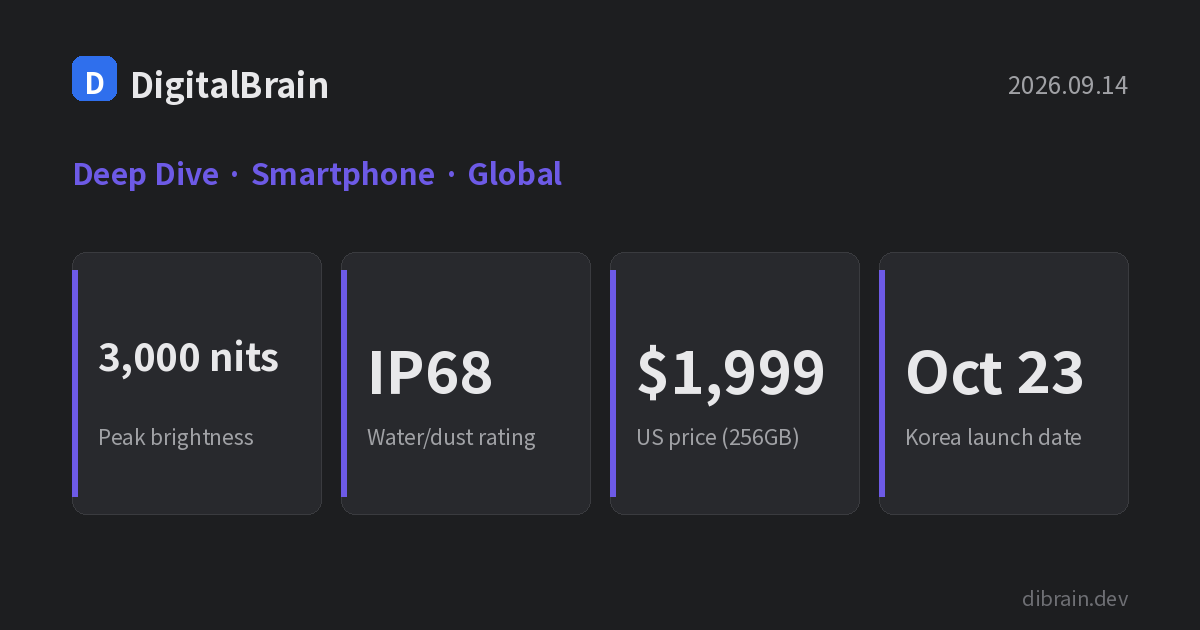
Apple unveiled its first foldable iPhone, the iPhone Duo, at its “Surprise and Shine” event on September 9. Announced alongside the iPhone 18 Pro lineup, it’s Apple’s long-awaited answer to a foldable category that Samsung has already iterated through eight generations of its Galaxy Z Fold line, putting the two devices under immediate comparison. Samsung shipped the original Galaxy Fold back in 2019, so this is Apple’s response seven years into the category — which makes the “why now, why this approach” question as interesting as the spec sheet itself.
iPhone Duo
| Spec | Detail |
|---|---|
| Inner display | 7.6-inch OLED, ProMotion, always-on |
| Outer display | 5.4-inch OLED, ProMotion, always-on |
| Peak outdoor brightness | 3,000 nits |
| Frame | Titanium |
| Water/dust resistance | IP68 |
| Chip | TBC |
| US price (256GB) | $1,999 |
| Korea price (256GB) | ₩3.29 million |
The chip is listed as TBC (to be confirmed) because, while the iPhone 18 Pro announced at the same event reportedly ships with the 2nm A20 Pro, Apple has not published an official spec sheet confirming the same chip inside the iPhone Duo. (Source: MacRumors)
Both the inner and outer panels support ProMotion’s variable refresh rate and always-on display, which reads as Apple trying to preserve the standard iPhone screen experience even on a folding form factor. What wasn’t detailed at the event is whether the inner display shows a visible crease, or how many open-close cycles the hinge is rated to survive — durability questions that typically only get answered once review units ship.
iPhone Duo vs. Galaxy Z Fold8
| Spec | iPhone Duo | Galaxy Z Fold8 |
|---|---|---|
| Inner display | 7.6-inch | 7.6-inch |
| Outer display | 5.4-inch | 5.5-inch |
| Frame | Titanium | Aluminum |
| Water/dust resistance | IP68 | IP48 |
| Weight | TBC | 53g lighter than iPhone Duo |
| Thickness (folded/unfolded) | TBC | Thinner than iPhone Duo in both states |
| US price (256GB) | $1,999 | $1,899 |
On paper, the two foldables sit in the same weight class for screen size: both have 7.6-inch inner displays, and the outer screens are nearly identical at 5.4 and 5.5 inches. The real split is in materials and durability. Apple went with a titanium frame and an IP68 rating, while Samsung kept its aluminum frame and IP48 rating in exchange for a lighter, thinner device. The iPhone Duo also costs $100 more at launch.
Buyers who prioritize water resistance and build durability have a clear case for the iPhone Duo. Those who care more about portability and weight are better served by the Galaxy Z Fold8. That said, a number of the iPhone Duo’s specs — including the chip — remain unconfirmed on an official spec sheet, so a real performance comparison will have to wait until after launch. (Source: TechRadar, GSMArena)
Zoom out to the category itself, and Samsung’s eighth generation brings years of accumulated hinge-engineering and software-optimization experience that a first-generation product can’t match overnight. Apple, on the other hand, is carrying over split-screen and multitasking features built for iPadOS onto a folding phone screen for the first time — how naturally those translate in daily use is the kind of thing that’s hard to judge from a spec sheet alone, and will really only be settled once review units are in hand.
Korea Availability
South Korea is among the iPhone Duo’s first-wave launch markets. Pre-orders open at 9pm KST on October 16, with the official on-sale date set for October 23. Korean pricing runs ₩3.29 million for 256GB, ₩3.59 million for 512GB, ₩4.19 million for 1TB, and ₩5.09 million for 2TB. A straight currency conversion of the $1,999 US price for the 256GB model comes out to roughly ₩2.67 million, meaning the Korean price is priced nearly ₩600,000 higher. While the standard iPhone 18 Pro lineup ships in 65 countries starting September 18, the foldable Duo follows on a separate schedule more than a month later. (Source: ZDNet Korea, Asia Economy)
That month-long gap is probably not incidental. Unlike the standard iPhone, which Apple has mass-produced annually for over a decade, the foldable is a brand-new form factor to manufacture at scale, and hinge-assembly yield issues would plausibly need extra time to iron out before a wider international rollout. Carrier pre-order promotions and subsidy amounts in Korea haven’t been announced yet, so the actual out-of-pocket price will need to be confirmed once carriers publish their offers.
Verdict
Apple’s first foldable has caught up to the Galaxy Z Fold8 in screen size, but that parity comes at a higher price than Samsung’s. It leads on water resistance and materials, but trails on weight and thickness. Coming late to the foldable market, Apple appears to have chosen a “more expensive, more durable” position — whether that positioning works will become clearer once Korean sales figures come in after the October 23 launch.
The bigger question is whether Apple’s brand alone is enough to expand a foldable category that, despite eight generations from Samsung, still hasn’t broken into the mainstream the way standard smartphones have. If the iPhone Duo pulls first-time foldable buyers away from flat iPhones rather than converting existing Android foldable owners, that would mark a bigger shift in the market than anything in the spec comparison above — and it’s a question that only sales data, not a launch keynote, can answer.